The Hodogaya Chemical Group believes that, as a corporate citizen, contributing to the sustainable development of the community is an important activity in carrying out its business. We are engaged in various community contributions including the nurturing of children through chemistry, environmental conservation activities in the regions where the Group’s plants are located, and the provision of value in both tangible and intangible forms that enrich people’s lives. In addition, if a disaster affecting an area where one of our key bases is located is designated as a major disaster by the Cabinet Office, and the damage to the area around the base is severe, we donate a certain percentage of the previous fiscal year’s earnings to the impacted prefecture.
In FY2025, total expenditures on social contribution activities amounted to 14.27 million yen. Of this amount, 10.17 million yen was spent on events and other activities in communities where our plants are located, while 4.10 million yen was spent on environmental improvement and other activities.
Furthermore, if a disaster occurring at one of our key sites is designated as an “especially severe disaster” by the Cabinet Office and the damage to the surrounding area is significant, we donate a certain percentage of the previous fiscal year’s profit to the affected prefecture. For example, in October 2019, when damage to Koriyama City caused by Typhoon No. 19 was designated as an especially severe disaster, we made a donation to Fukushima Prefecture to support recovery efforts. Since FY2020, no disasters have met the criteria for such donations.
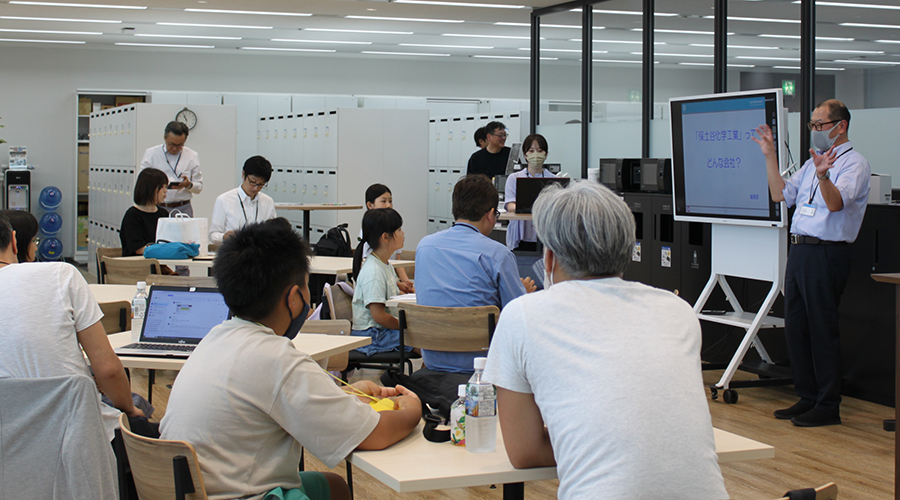
The Hodogaya Chemical conducts hands-on science experiment classes at elementary schools, with our employees serving as instructors, to foster children’s interest in and understanding of chemistry. In FY2025, approximately 90 students from three elementary schools located near our plant participated in these classes. We also actively participate in a chemistry experiment for children organized by a Public Interest Incorporated Association, providing hands-on chemistry classes to approximately 200 elementary school students each year.
The Hodogaya Chemical Group works together with local governments and members of local communities as a responsible member of society, striving to contribute to safe and secure communities.
As part of these efforts, we provide portions of our plant grounds free of charge for public use. At the Koriyama Plant, the land is used for public infrastructure including an east-west passage at Koriyama Station, a municipal bicycle parking facility, and a taxi waiting area. At the Nanyo Plant, it is used for facilities including the Shin-Nanyo Baseball Stadium.
In the area of disaster preparedness, the Koriyama Plant, Koriyama City, and the Koriyama Branch of Fukushima Kotsu have entered into an agreement on the evacuation of bus vehicles in the event of a disaster.
When Typhoon No. 19 struck in 2019, part of the plant grounds was promptly made available as an evacuation site, helping to reduce damage to public transportation vehicles. We will continue to actively cooperate in initiatives that help protect the safety of local communities.


Materials Safety Convention on June 19, 2025, the Nanyo Branch of Hodogaya Logistics Co., Ltd. received an award in the Outstanding Business Establishment category, together with 13 other organizations in Yamaguchi Prefecture. The award was presented following a recommendation by the Shunan City Fire Department, which highly evaluated the branch’s longstanding efforts to ensure the safe management of hazardous materials facilities and appropriately prevent accidents and disasters. Encouraged by this recognition, we will continue to ensure rigorous safety management of hazardous materials facilities and thorough accident and disaster prevention, while actively cooperating with and contributing to local safety activities, including those of the Shunan City Hazardous Materials Safety Association.

The Hodogaya Chemical Group actively promotes educational support activities, including participation in hands-on experiment events and outreach classes at elementary schools. Through these activities, we aim to convey the fun and wonder of chemistry to children who will lead the next generation, while helping to advance science and technology and foster environmental awareness.
In August 2025, we participated in the Summer Vacation Children’s Chemistry Experiment Show held at the Science Museum. In a hands-on experiment titled “Making an Ocean Bottle” using its natural dyes, children enjoyed hands-on learning about the properties that cause water and oil to separate. The event proved extremely popular, with all reservation slots quickly filling each day. We also conduct outreach classes at our business sites in cooperation with local communities. In October 2025, employees from the Nanyo Plant visited two nearby elementary schools, where they conducted experiments separating ink through capillary action and “creating flags with liquids” using differences in density. Through familiar phenomena, the activities encouraged children to take an interest in chemistry. In February 2026, the Koriyama Plant held a class on the theme of “water” for fourth-grade students at a nearby elementary school. The class included an experiment filtering muddy water using a filter made from a plastic bottle and a liquid nitrogen demonstration. Employees also introduced the Koriyama Plant’s environmentally conscious initiative of treating water drawn from a nearby river before returning it to the environment, providing an opportunity for deeper learning linked to the SDGs and the science curriculum.


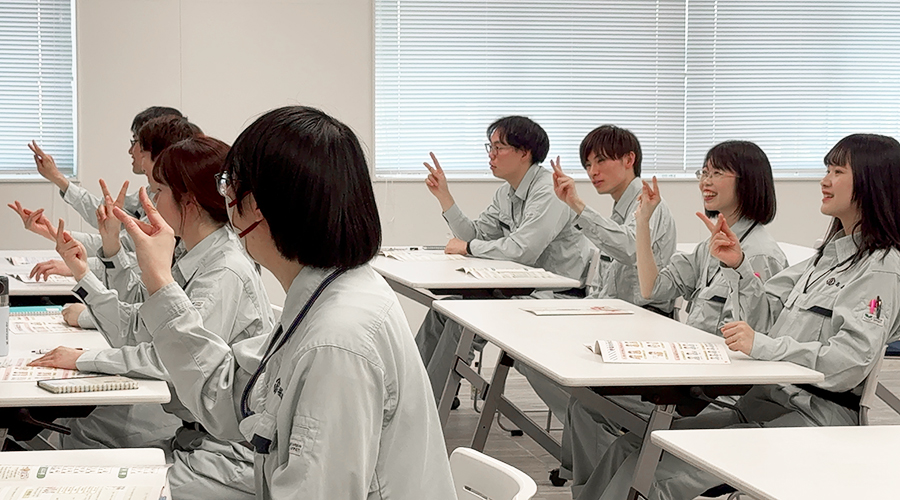
To foster understanding of people who are deaf or hard of hearing and promote active communication, the Koriyama Plant has been hosting the “Sign Language Course for Businesses” organized by Koriyama City since FY2023, conducting five sessions in FY2025.
In the course, participants learned simple self-introductions, greetings, and practical sign language expressions applicable to the workplace. Unlike learning through reference books or videos, practicing in person allowed attendees to grasp subtle nuances in expression and intricate finger movements.
Going forward, the plant will continue working to further deepen mutual understanding and communication while remaining mindful and considerate of others’ circumstances.
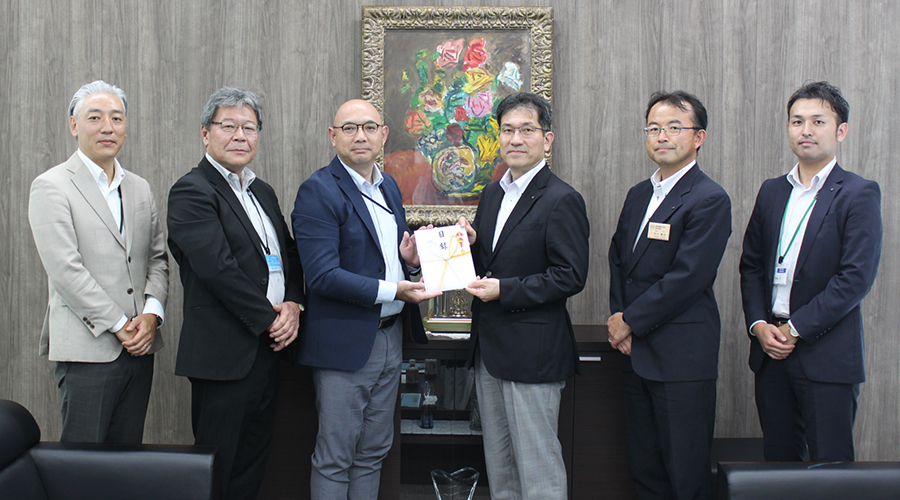
With the aim of returning a portion of the profits generated by its Functional Colorants business to society, the Hodogaya Chemical Group made a donation through Japan’s corporate hometown tax program.
The Group’s Koriyama Plant, which manufactures organic and optical device materials, is located near the East Exit of JR Koriyama Station in Fukushima Prefecture. In a desire to aid in the recovery of the prefecture hosting the plant, mitigate the impact of harmful rumors on local crops, and promote agriculture—guided by Hodogaya Chemical’s Management Philosophy of “contributing to the creation of an environmentally conscious society”—the Group contributed to Fukushima Prefecture’s “Project for Creating a Sustainable Regional Agriculture Model in Collaboration with Fukushima University.”
To support the regional revitalization of Fukushima Prefecture, with which it shares longstanding ties, the Hodogaya Chemical Group will continue to partner with local communities and strive for sustainable regional development.
Held annually from November through January, the “Big Tree Pageant Festa in KORIYAMA” brings festive illuminations to the area around Koriyama Station. The Koriyama Plant supports this community event by utilizing its perimeter fences stretching from the station’s East Exit to the plant’s main gate. Featuring decorative illuminated motifs woven into curtains of light, the installation provides a popular photo spot that delights local citizens throughout the winter season.

In August 2025, we held our first head office tour, inviting employees’ families. With the aim of deepening understanding of Hodogaya Chemical and each person’s work by seeing the operating office and the employees working there, on the day of the event, participants toured each area of the head office floor, experienced web conferences in the large conference room, and tried the healthy lunches we usually eat.
The title on the name tags and realistic business cards prepared for each participant was “Special Supporter.” For busy employees, having their families understand their work and environment is the greatest support. All employees will continue to strive to do work that we can be proud of to our families, and by extension, to our communities and society.
The Hodogaya Chemical Group actively works to conserve biodiversity.
On April 26, 2025, we participated in the “Lake Inawashiro Clean Action,” a cleanup activity along the shores of Lake Inawashiro. Carrying out cleanup activities amid the area’s rich and beautiful natural surroundings gave participants a firsthand appreciation of the importance of environmental conservation. It also provided a valuable opportunity to build connections through warm interactions with local residents and fellow officers and personnel. Every member, including new hires, takes an active role in social contribution activities. We will continue to promote community-based environmental conservation activities toward the realization of a sustainable planet and society.

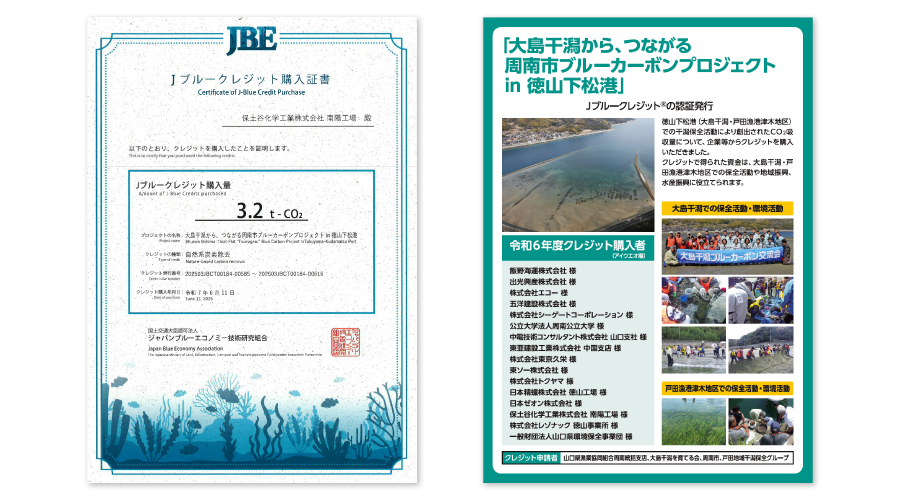
This project (“PJ”) is an advanced initiative in Shunan City, located along the Seto Inland Sea, that leverages the natural power of fishing ports and surrounding areas to help prevent global warming and revitalize the local community.
The central site of the PJ, Oshima Tidal Flats, is Japan’s first 29-hectare artificial tidal flat with the primary goal of promoting the autonomous regeneration of clams. It is a valuable habitat supporting a rich ecosystem, home to seagrasses such as eelgrass, clams, oysters, octopuses, small fish, and a diverse range of other organisms.
Seagrass beds not only absorb carbon dioxide from the seawater but also serve as nurseries for juvenile fish, contributing to the recovery of fishery resources.
The PJ has expanded its activities, with seagrass restoration and planting efforts, including eelgrass, underway at Heta (Tsugi) fishing port. In addition, local schools, citizens, companies, and government agencies collaborate to monitor the marine environment and provide experiential learning, helping to raise environmental awareness.
By participating in marine environmental improvement activities that support building future communities in harmony with nature, centered on blue carbon initiatives for a decarbonized society, we aim to contribute to biodiversity enhancement and local climate change mitigation*, while also enhancing corporate value.
※ As a “blue carbon ecosystem” that plays a vital role in absorbing and sequestering CO2, it has been certified for 95.6 t-CO2 credits in 2025 (of which 3.2 t-CO2 are attributable to our Company).
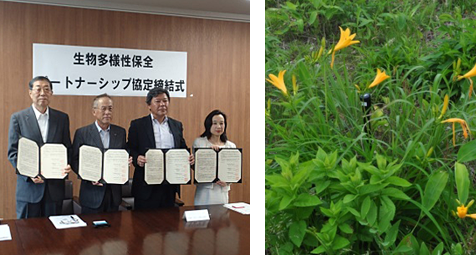
Hodogaya Agrotech Co., Ltd. (HAT), a group company that manufactures and sells agricultural chemicals, received a request from Nagano Prefecture to protect rare plants with the HAT diet repellent “Rantekuta” in 2016. Nagano Prefecture, Kirigamine Nature Conservation Council, Daido Shoji Co., Ltd. and HAT signed a “Biodiversity Conservation Partnership Agreement” and conducted a demonstration test of sika deer measures at Kirigamine Plateau.
As a result of three years of continuous testing, it was confirmed that the population of Nikko daylilies nearly tripled at the test site on the Kirigamine Plateau. Because rare flora also inhabit the Utsukushigahara Plateau, we have extended the agreement to date at the request of Nagano Prefecture and commenced demonstration tests for precious plants there—including fireweed, thistles, fragrant orchids, and scabiosa—in cooperation with The Utsukushi-ga-hara Open-Air Museum.
“Rantekuta” is a pesticide based on whole egg powder used as a raw material for pasta, cakes, puddings, etc.
Utilizing the technology cultivated over many years by HAT, we cooperate and support environmental conservation activities in Kirigamine / Utsukushigahara Plateau.
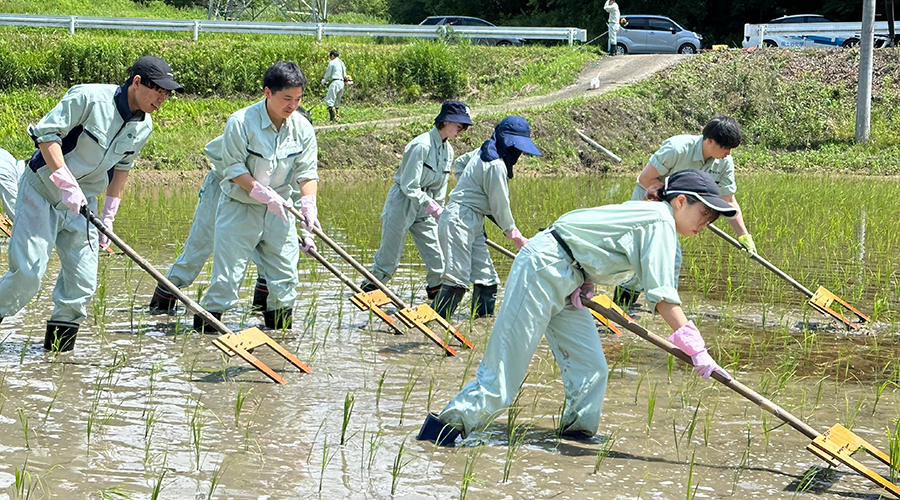
Koriyama Plant personnel volunteer to take part in volunteer weeding for Niida Honke.
A sake (rice wine) brewery in Koriyama City, Fukushima Prefecture, Niida Honke brews and sells sake and fermented foods that include Niida Shizenshu, a 100% pure sake made from brewer’s rice grown without the use of any pesticides or chemical fertilizers.
On the day of the volunteer event, 21 people from the Koriyama Plant took part and borrowed Nakano-type weeding implements to weed three rice fields.
A Niida Honke staff member taught us directly how to use the weeding implements and provided us with details of how sake is made. It was very refreshing and fun to work in a rice field for the first time and talk directly with local people. Through this volunteer work, we were able to interact with local people. It was also a valuable opportunity to experience nature and Japanese culture. I would like to continue to actively participate in activities that are of benefit to the local community and to society as a whole.
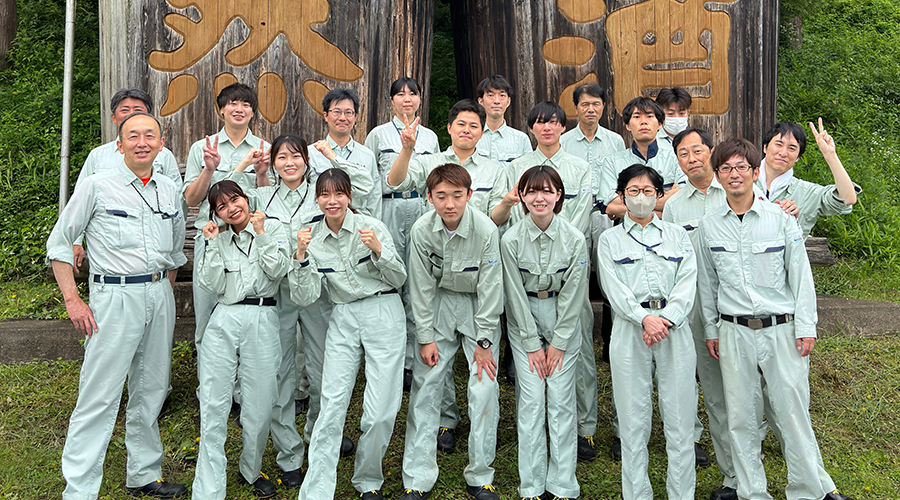
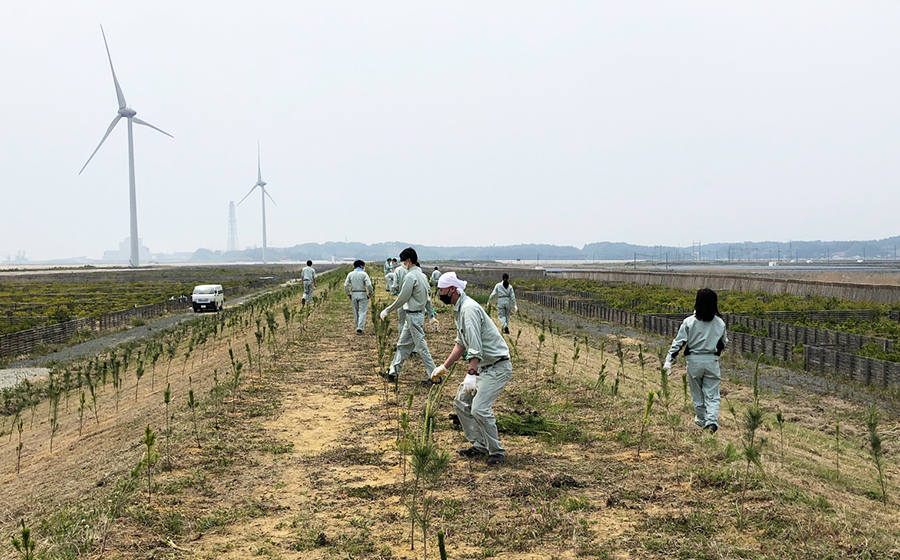
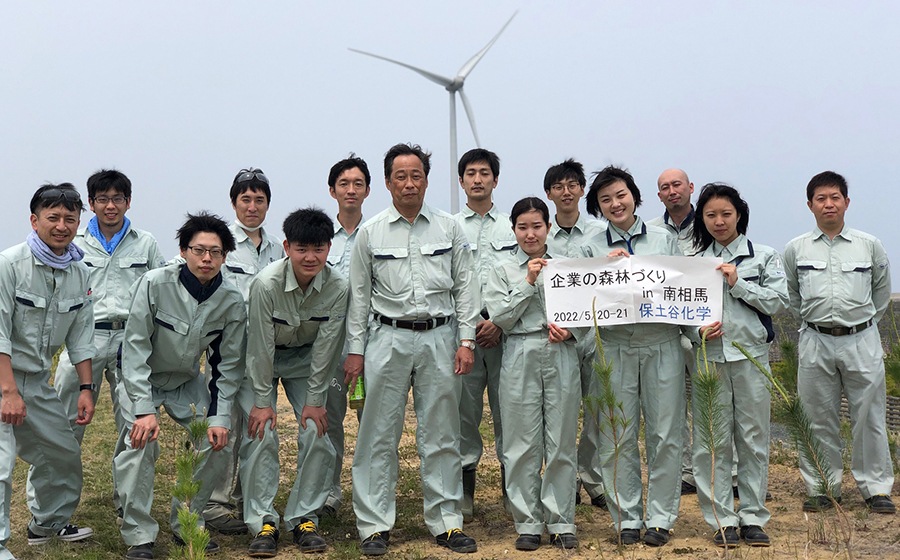
In 2020, the Koriyama Plant participated in the Corporate Afforestation initiative, and from FY2021, started tree-planting activities aimed at regenerating ‘coastal disaster prevention’ forests in the Minamisoma district. This activity is a five-year plan, in which 750 black pine trees were planted in the first and second years, and a total of 3,750 black pine trees will be planted over 0.75ha of land over the remaining three years. In the first year, 30 personnel from the plant participated, and in the second year, 16 personnel participated. Over the course of two days, we planted trees and cleared undergrowth as part of the afforestation activities.
I participated in both the first and second years and carefully planted each tree. I believe that we were able to contribute to environmental conservation through our tree planting activities. I would like to continue to undertake activities that contribute to the environment and society.
The “Honeybee Friendship Project” is an activity for cultivating flowers with the objective of protecting honeybees and other flower-visiting insects. Starting with the Yokohama Plant, it is being expanded to vacant lots and flowerbeds at the Koriyama Plant, Nanyo Plant and Tsukuba Research Laboratory (total cultivation area: about 600m2).
We started with making flower beds while researching on the internet, watching gardening programs, and referring to the well-maintained sidewalks. We were thinking of how much fun it would be to have so many flowers in bloom that you could feel the different seasons. While growing plants from seeds, there are types that can grow well even when planted directly in the soil, and types that are grown in nurseries and transferred to soil when their roots and leaves become firm. Some of the seedlings were damaged by mold in the nursery, but we had a fun time plowing the soil and weeding the plants.
Many trucks go in and out of the Yokohama Plant every day. I hope it will become a place where those truck drivers will look forward to seeing the flowerbeds and say, “Ah! The flowers are in full bloom again today.”

Accounting for two-thirds of Japan’s land area, forests contribute greatly to people’s lives, including by recharging sources of water, conserving the country’s land, mitigating the effects of global warming, and supplying timber and forest products. Cyclic use is made of man-made forests in a cut, use, and plant sequence, but there is a serious shortage of forestry workers to take on this work, and securing a workforce is becoming a major problem. For several years after planting, it is a battle against weeds and trees that hinder the growth of the seedlings. Mechanization having not progressed that far, clearing weeds under the scorching sun in midsummer can be said to be the most difficult task.
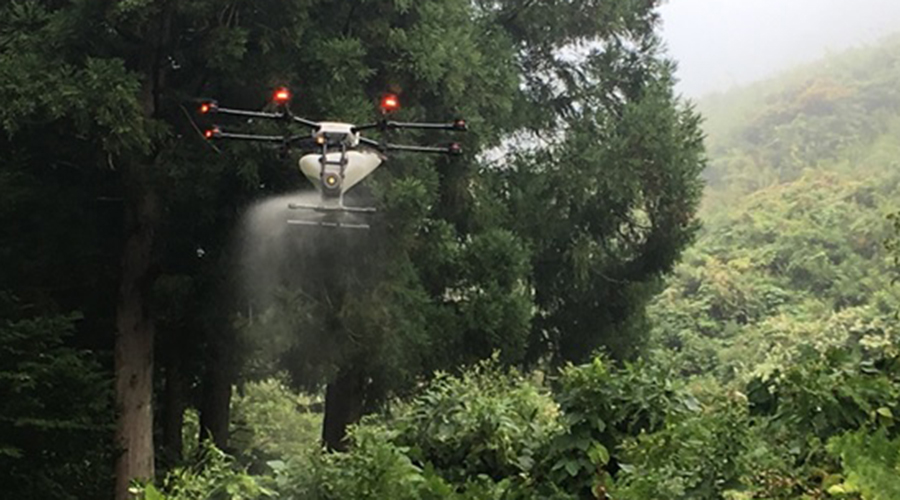
Engaged in the manufacture and sale of agricultural chemicals, HODOGAYA AGROTECH Co., Ltd. has established a new technology that sprays herbicides developed for use in forests by drone. Devised to save labor, this development has led to an improvement in the working environment by freeing workers from a sweaty, physically draining task. Also protecting seedlings from wild animals by supplying repellents and seedling protection materials, we are working to support sustainable forestry with the power of chemistry.
* The term smart forestry refers to forestry that utilizes digital management and/or information and communication technologies (ICT) as well as to forestry by means of safer, more efficient automated machinery. (Forestry Agency)